
On this page
Your needs, this model
Does it fit your priorities?
Do you need two separate small dishes at once, each with its own heat setting?
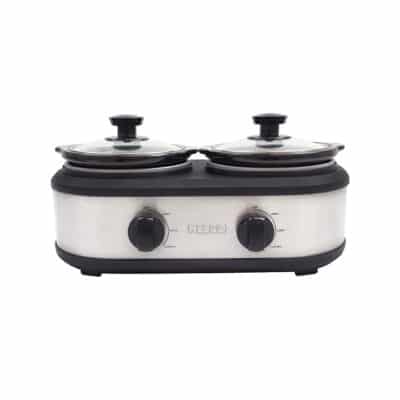
The station has two 1.25-quart pots and a separate three-setting dial for each; the capacity is per pot, not a single 2.5-quart bowl.
Explore this need in the finder →Would direct manual dials suit you better than digital time presets?
Each pot uses a manual High/Low/Warm dial. A digital countdown or preset timer is not documented for this model.
Explore this need in the finder →Would manual Warm selection suit you better than a timed automatic Warm handoff?
The separate Warm dial is manually selected; an automatic transition after a timed cycle is not documented for SC-1DSS.
Explore this need in the finder →The NESCO SC-1DSS is best understood as a small dual-dish cooker, not as one 2.5-quart pot. It has two separate ceramic pots, each rated at 1.25 quarts, with an individual High, Low and Warm dial for each side. That arrangement lets you keep two modest dishes apart and choose a setting for each. Its useful distinction is the split, independently controlled serving setup—not the combined number printed beside its capacity.
Two small vessels solve a different problem than one larger crock
The pair is useful when you regularly want two different foods available together: perhaps a dip beside a sauce, or beans beside another small side for a gathering. Each pot lifts out for serving, and the clear glass lids make it possible to check the contents without moving the whole unit. The two sides can be set separately, so one dish need not share the other's control selection. NESCO gives dips, appetizers and tacos as examples; the broader decision is whether your meals genuinely benefit from two small batches at once.
Do not shop for this as though it offers a single 2.5-quart cooking bowl. Each included pot is 1.25 quarts. If a recipe or your regular batch needs a continuous two-quart vessel, this split station is the wrong fit even though the two nominal capacities add to 2.5 quarts. The ordinary capacity questions in a cooker finder refer to the largest single vessel, while the separate two-dish question captures the value of this model. It can suit someone who needs parallel sides but should fail a requirement for a single pot of at least two quarts.
The capacity also places real limits on the recipes it can handle. A 1.25-quart side pot is not a six-quart family-meal cooker, and the pair does not create one large pot for a roast or a big soup batch. Use the individual-batch amounts that fit each small vessel rather than dividing a large recipe by the total capacity alone. The manufacturer page confirms the nominal volumes, but no reviewed cooking test establishes serving counts or performance for particular recipes.
Manual dials, not a clock-based cooking routine
Each control offers High, Low and Warm. That is a straightforward way to choose how each dish is handled, especially when one side should remain warm while you work with the other. The manufacturer’s product description presents separate three-setting dials; it does not describe a digital countdown, an entered cooking duration, delayed start, or an automatic switch to Warm when a timer ends. Treat Warm as a setting you select, not as a promise that the cooker will manage the transition for you.
If your essential requirement is for a cooker to finish a timed cycle and switch itself to Warm, compare a model whose exact manual documents that behavior. If you want to select a target time for dinner or delay the start, the SC-1DSS page does not establish either function. It is closer to two small manual cookers sharing one base than to a programmable multicooker. In a finder, the manual-dial and separate-dishes answers are relevant; choosing a digital timer or scheduled finish should rule it out unless later exact-model documentation adds those functions.
What the construction does—and does not—tell you
NESCO specifies removable ceramic pots, tempered-glass lids and a stainless-steel exterior on the 170-watt base. The stainless finish describes the outer housing; the food vessels are ceramic, not stainless inserts. The page says the pots lift out for serving and easier cleaning, but the accessible product specification does not establish dishwasher, oven, microwave or stovetop safety. Removable does not mean every heating or cleaning method is supported. Check the SC-1DSS care guide before relying on any of those uses, and follow its instructions for hot ceramic and glass parts.
The manufacturer lists the appliance at 9.25 pounds and gives dimensions of 17.087 by 7.244 by 10.315 inches. It does not identify the axes alongside those figures, nor clarify whether the listed weight refers to the bare cooker or a shipping package. If cupboard clearance, a tight counter, or frequent lifting is an essential part of your decision, confirm the measurements and weight basis with NESCO rather than assuming the numbers describe open-lid clearance or the empty unit.
Who should compare another NESCO instead?
For two single-dish portions that do not need independent controls, a small one-pot cooker such as NESCO’s 1.5-quart SC-150R may be simpler. For a larger single recipe, compare a four- or six-quart model such as the analog SC-4-25 or the digital DSC-6-25, while checking their different capacity and control tradeoffs. If you want two larger pots, Crock-Pot’s MultiMeal family is a different scale: its documented paired vessels are 3.7 quarts each, so it is not a like-for-like tabletop serving station.
The SC-1DSS makes the most sense when two small dishes need separate manual settings and should be served side by side. It is a poor match for a single larger meal, a timer-driven cook-and-hold cycle, or any setup that depends on undocumented vessel-care features. The manufacturer showed the exact SC-1DSS in stock when its U.S. page was checked on October 25, 2026; availability can change. Decide first whether two 1.25-quart bowls are the arrangement you actually need. The 2.5-quart total should not obscure that central tradeoff.
Key details at a glance
| Nominal removable-pot capacity | 1.25 qt |
|---|---|
| Published outside dimensions | Exact PDP lists 17.087 × 7.244 × 10.315 in without axes; open-lid clearance is unknown. |
| Manual heat-setting dial | Yes |
| Warm-setting guidance | Each pot has a manually selected Warm setting. An automatic post-timer transition and a holding limit are not documented in the inspected product/catalogue extracts. |
| Separate Little Dipper food warmer included | No |
| Casserole-format insert | No |
More specifications and setup details
| Removable pot material | ceramic |
|---|---|
| Separate Party Dipper warmer included | No |
| Published main-cooker control interface | Two separate manual control dials; each pot has High, Low and Warm selections. The manufacturer page and catalogues do not describe a cooking timer or scheduled finish. |
| Two separate dishes cook at once | Yes |
| Double Dish insert capacity note | Two independent 1.25-qt ceramic vessels; total 2.5 qt across both, never one 2.5-qt vessel. |
| Stainless-steel insert | No |
Use the exact model’s instructions for operating limits, supplied equipment and version differences.
Sources for this assessment

Shortlist a cooker for the way you cook.
Choose the cooking functions and handling requirements you will actually use, then verify the exact model and supplied parts.