
On this page
Your needs, this model
Does it fit your priorities?
Do you need a digital timer with preset High/Low durations rather than a free-entry countdown?
The guide offers only 4 or 6 hours on High and 8 or 10 hours on Low. The timer counts down the selected preset, then the cooker moves to Warm.
Explore this need in the finder →Do you need the cooking cycle to switch automatically to Warm when its timer ends?
Yes. The documented timed preset cycle transitions to Warm after cooking; the guide limits Warm to already-cooked food and no more than four hours.
Explore this need in the finder →Is a four-quart vessel the size you want rather than a six-quart pot?
Its nominal single-pot capacity is four quarts; choose a four-quart range if a six-quart insert would be larger than you need.
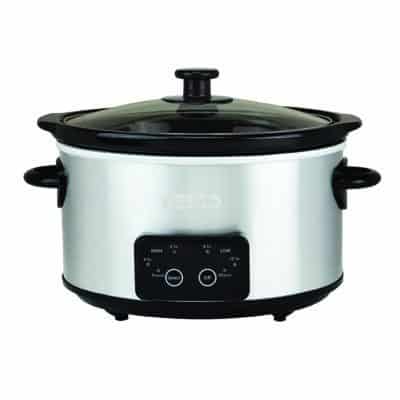
Explore this need in the finder →The NESCO DSC-4-25 is a four-quart digital slow cooker whose timer gives you four fixed cooking choices: four or six hours on High, or eight or ten hours on Low. When the selected cycle ends, it shifts to Warm. That makes it more structured than a manual dial, but less flexible than a cooker that accepts a freely chosen duration or a target ready time. If those fixed periods fit the recipes you actually make, the smaller pot and automatic handoff are its strongest reasons to consider it.
Know what its digital timer does
The control is not a meal scheduler. You choose one of the manufacturer's preset heat-and-time combinations when cooking begins; the timer counts down that choice and the unit changes to Warm when it finishes. There is no documented delayed start or “have dinner ready at 6 p.m.” setting. The Warm state is for food that is already cooked, not a cooking temperature, and the guide says to keep food on Warm for no more than four hours. Plan to start the recipe at an appropriate time rather than treating the unit as an unattended finish-time scheduler.
That distinction matters when comparing it with two common alternatives. A manual cooker leaves the cooking duration to you and has no automatic timed transition. A flexible digital countdown lets you enter a duration that is not limited to a short list. NESCO's DSC-4-25 is in a third, narrower category: its times are preset. If the four options are adequate, the countdown and Warm handoff can simplify a routine; if you need a particular cook time outside those choices, another control scheme is a better fit.
Four quarts is a useful middle size, with a fill caveat
The nominal capacity is four quarts in a removable ceramic pot. It sits between a 1.5-quart cooker for small servings, sauces or dips and a six-quart pot for larger batches. A four-quart rating does not guarantee a particular number of portions, and a bigger vessel is not automatically better: the NESCO guide recommends that the pot be at least half full for optimal results. If most of your recipes make a very small amount, look at a genuinely smaller cooker rather than expecting the DSC-4 to behave like a one-quart saucepan. If your usual batches are close to the top of a four-quart insert, compare a six-quart model instead and follow the fill limits in its manual.
The exact product page describes the ceramic crock as refrigerator- and oven-safe, but it does not give a maximum oven temperature. Treat “oven-safe” as a limited manufacturer statement, not permission to broil it, heat it empty or assume it can go from refrigerator to a hot oven. The care guide warns that sudden temperature changes can crack the ceramic. Let the pot cool before cleaning or placing it on a cold surface. The lid and crock are listed as dishwasher-safe; the powered base is not, and the instructions say to wipe it clean rather than immerse it.
What the cycle can—and cannot—take off your hands
During cooking, the clear glass lid lets you check progress without routinely lifting it. The manual points out that removing the lid lets heat escape and extends the cooking time; resist the temptation to stir or peek unless your recipe needs it. It also advises using a heat-resistant, nonflammable counter surface, not running the base empty, and avoiding frozen food in a preheated crock. Those are practical limits for a ceramic slow cooker, not optional accessories or extra functions.
The maker's published wattage is inconsistent: the current product page says 210 watts, while its 2025 catalogue lists 200 watts for DSC-4-25. I would not use either number to decide whether this is the right cooking size or to infer how fast it heats. The PDP also lists the appliance weight as one pound alongside dimensions of 13 by 13 by 11 inches; that weight entry is not a dependable lifting or counter-clearance measurement. If weight, storage space, or exact clearance is essential, confirm it with NESCO before buying. The dimensions do not identify width, depth and height axes or open-lid clearance.
Who should compare another model?
Choose a different cooker if you need a specific finish time, delayed start, a continuously entered countdown, or a larger single pot. If you want a four-quart ceramic insert but prefer a simple dial, the NESCO SC-4-25 is the direct same-size analog alternative; it forgoes the DSC's timed preset menu. The six-quart DSC-6-25 uses the same digital family controls with a larger pot, but the manufacturer currently shows that SKU out of stock. A small 1.5-quart NESCO cooker is a better starting point for dips or one-person batches, not a substitute for a four-quart family recipe.
For a cook who can choose among the four documented periods and wants a four-quart bowl that automatically moves to Warm, the DSC-4-25 is easy to understand. Its limits are equally specific: no target-ready-time scheduling, no free-entry timer, and an unresolved published weight/wattage conflict. Match the cycle to your recipe and batch size before choosing the touchscreen over a manual cooker.
Key details at a glance
| Nominal removable-pot capacity | 4 qt |
|---|---|
| Manual heat-setting dial | No |
| Removable pot is oven-safe | Yes |
| Removable pot material | ceramic |
| Removable pot is dishwasher-safe | Yes |
Use the exact model’s instructions for operating limits, supplied equipment and version differences.
Sources for this assessment

Shortlist a cooker for the way you cook.
Choose the cooking functions and handling requirements you will actually use, then verify the exact model and supplied parts.