
Your needs, this model
Does it fit your priorities?
Can a temperature probe track food during a timed slow-cook cycle?
Yes. The 33866 guide says the sensor can be used in any mode to display food temperature, including the separate Low, Medium or High slow-cook routine.
Explore this need in the finder →Does a timed slow-cook cycle switch itself to Warm?
Yes. After the selected Low, Medium or High cycle, the guide says the cooker shifts to Warm, subject to a 24-hour combined cooking-and-Warm limit.
Explore this need in the finder →Can this model run a sous-vide water bath as well as ordinary slow cooking?
Yes. Its model-matched guide has a sous-vide routine using preheated water and the target-temperature hold setting; searing is a separate step.
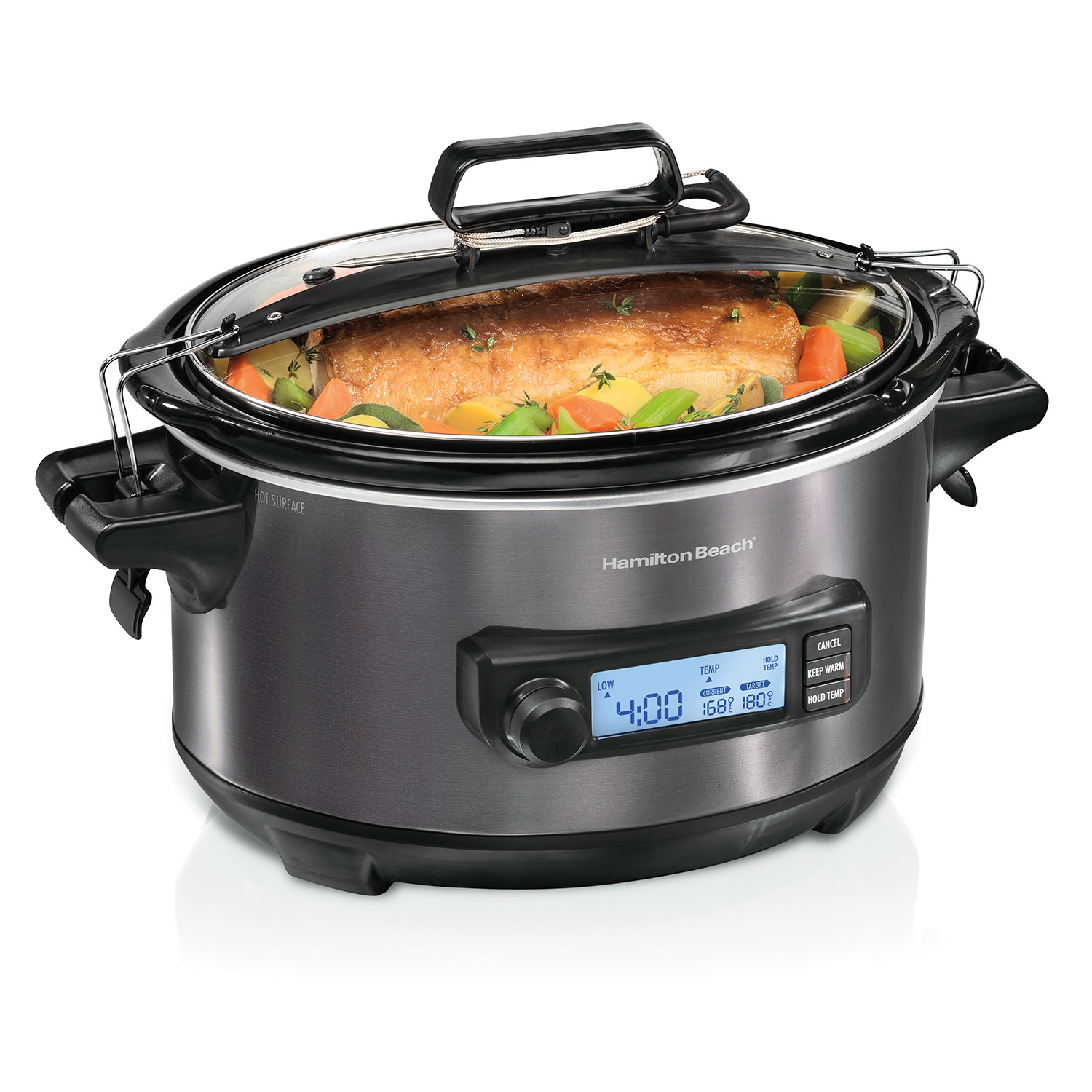
Explore this need in the finder →The Hamilton Beach 33866 is a six-quart Temp Tracker slow cooker for cooks who want more than a simple Low/High thermostat: it measures food temperature with a wired probe, displays the reading, and supports both timed slow cooking and a separate target-temperature routine. That extra control is useful when a recipe depends on doneness or a steady hold, but it comes with a more involved setup than a manual dial. This is the model whose instructions I could match to the 33866 code, so the operating details below are specific to this version rather than assumptions about every Temp Tracker.
What the probe adds
Hamilton Beach describes a six-quart crock sized for examples such as a six-pound chicken or four-pound roast. The probe reports the current internal food temperature; the exact guide also uses it in ordinary slow-cook mode and in a separate TEMP program. That distinction matters. With Low, Medium or High, you choose a cooking duration of up to 24 hours, and the cooker switches to Warm when that timed cycle ends. The probe can be used in that cycle to monitor food temperature, but the cooker does not decide that a recipe is finished solely from a probe reading in the way the target-temperature mode does.
In TEMP mode, the guide instructs you to connect and place the sensor, choose a heating level and a food target from 100°F to 200°F, then choose whether to hold that target for a selected period or switch to Keep Warm after the target is reached. The display shows current and target temperatures. The manual illustrates the probe through the lid or directly in the crock, while the product page advertises four probe positions. This is a useful arrangement for a roast, yogurt, fondue or a controlled water bath; it is not a substitute for choosing an appropriate recipe, positioning the sensor correctly, or checking food-safety guidance for the food being cooked.
A real sous-vide routine, with an important boundary
The manual includes sous-vide guidance and says to begin with preheated water, then use the cooker to maintain the selected temperature. It is therefore a temperature-controlled bath routine rather than a fast water heater. A sealed bag of food must be arranged so that it remains submerged, and the manufacturer’s guide calls for separate timing based on the food and thickness. When finished, searing is a separate step in another pan, under a broiler, or on a grill; the cooker does not brown food in its crock.
For slow-cooker meals, the 33866 gives you more scheduling flexibility than a manual dial because it can count down and move to Warm. That is not permission to leave food in Warm indefinitely: the guide limits the combined cooking and warming run to 24 hours before shutoff. Warm is intended for food that has been thoroughly cooked, not for cooking raw ingredients or reheating cold leftovers. A timed cycle also is not a delayed start; it begins when you program it.
Pot, lid and travel details
The clip-tight lid and wire retainers are a genuine practical benefit if you take the cooker to a gathering. Secure them for transport only, and carry the base by its handles. The glass lid is not a sealed storage lid. Hamilton Beach’s instructions say to store it ajar, and not to latch it while the cooker is put away. The crock and lid are dishwasher-safe, but the maker specifically warns against the dishwasher’s SANI cycle. The crock is microwave-safe and oven-proof, though it should never be heated empty or put on a stovetop burner. The glass lid is not for an oven, microwave or stovetop.
The 33866 page gives a six-quart capacity and food-size examples but no outside dimensions, empty weight or open-lid clearance. If your shelf opening or lifting limit is a hard constraint, get measurements for the exact unit rather than borrowing dimensions from another six-quart Hamilton Beach. The removable crock is still a substantial vessel to move when full, and the sealed-bag water-bath routine needs enough space for bags without overfilling it.
Who should choose it—and who should not
Choose the 33866 when you specifically want a probe that can report internal temperature during slow cooking, a target-temperature hold mode, or a manufacturer-described sous-vide bath in the same appliance. Its programmable Low/Medium/High cycle and automatic Warm transition also suit someone who wants a chosen finish time without a dial-only routine. Compare it with the less complicated Hamilton Beach 33665G if you only need Low, High and manually selected Warm; that model has no timer or probe. The Advanced Temp Tracker 33867 is a distinct six-quart sibling with its own dimensions and ceramic-pot claim, but its product page does not establish the same detailed controls or probe use during slow cooking. Do not use one model’s manual as a substitute for the other’s instructions.
Hamilton Beach’s product page showed the 33866 out of stock when checked on October 24, 2026; that is a dated snapshot, not a promise about future inventory. The assessment is based on the exact product page and the guide listing model 33866, type SC76, at 120 V, 60 Hz and 290 W. It is not an ownership report or a laboratory test. If precise temperature control is your main reason to buy, confirm the manual, included probe and current package contents for the exact model before checkout.
Key details at a glance
| Nominal removable-pot capacity | 6 qt |
|---|---|
| Published outside dimensions | The exact manufacturer page does not publish closed-body dimensions, empty weight or open-lid clearance; do not substitute sibling 33867 measurements. |
| Sous-vide water-bath mode | Yes |
| Lid clips for transport | Yes |
| Pressure-cooking program | No |
| Manual heat-setting dial | No |
| Timed cooking controls | The exact page advertises a countdown display. The model-matched guide says Low/Medium/High time can be selected up to 24 hours, then the unit automatically shifts to Warm; total continuous cooking plus Warm is limited to 24 hours. In TEMP mode, the probe is required and the guide describes a chosen 100–200°F food target followed by either selected HOLD TEMP time or Keep Warm. The exact minimum time increment is not stated here. |
| Removable pot and lid care | The exact 33866 guide says crock and glass lid are dishwasher-safe without the SANI cycle; the crock is microwave-safe and oven-proof but not for a burner and must not be heated empty. The glass lid is not for an oven, microwave or stovetop. Avoid sudden temperature changes. |
| Warm-setting guidance | Following a timed Low/Medium/High cycle, the exact guide automatically switches to Warm, but the combined cook-and-Warm run may not exceed 24 hours. Warm is for thoroughly cooked food, not for cooking raw ingredients or reheating cold leftovers. Food temperature can continue to rise while in Keep Warm. |
| Removable pot is oven-safe | Yes |
| One Pot program usable for slow cooking | No |
| Removable pot is stovetop-safe | No |
| Removable pot is dishwasher-safe | Yes |
| Published main-cooker control interface | Digital display, Start/Select control, Cancel, Keep Warm and Hold Temp buttons. The manual identifies two separate routines: timed Low/Medium/High slow cooking and probe-required target-temperature TEMP mode. |
| Maximum combined cooking and Warm run before shutoff | 24 hr |
Use the exact model’s instructions for operating limits, supplied equipment and version differences.
Sources for this assessment

Shortlist a cooker for the way you cook.
Choose the cooking functions and handling requirements you will actually use, then verify the exact model and supplied parts.